
MANAGEMENT SYSTEMS
ISO 9001 Explained: A Practical Guide for SHEQ Professionals
Last reviewed: June 2026 • 11 min read
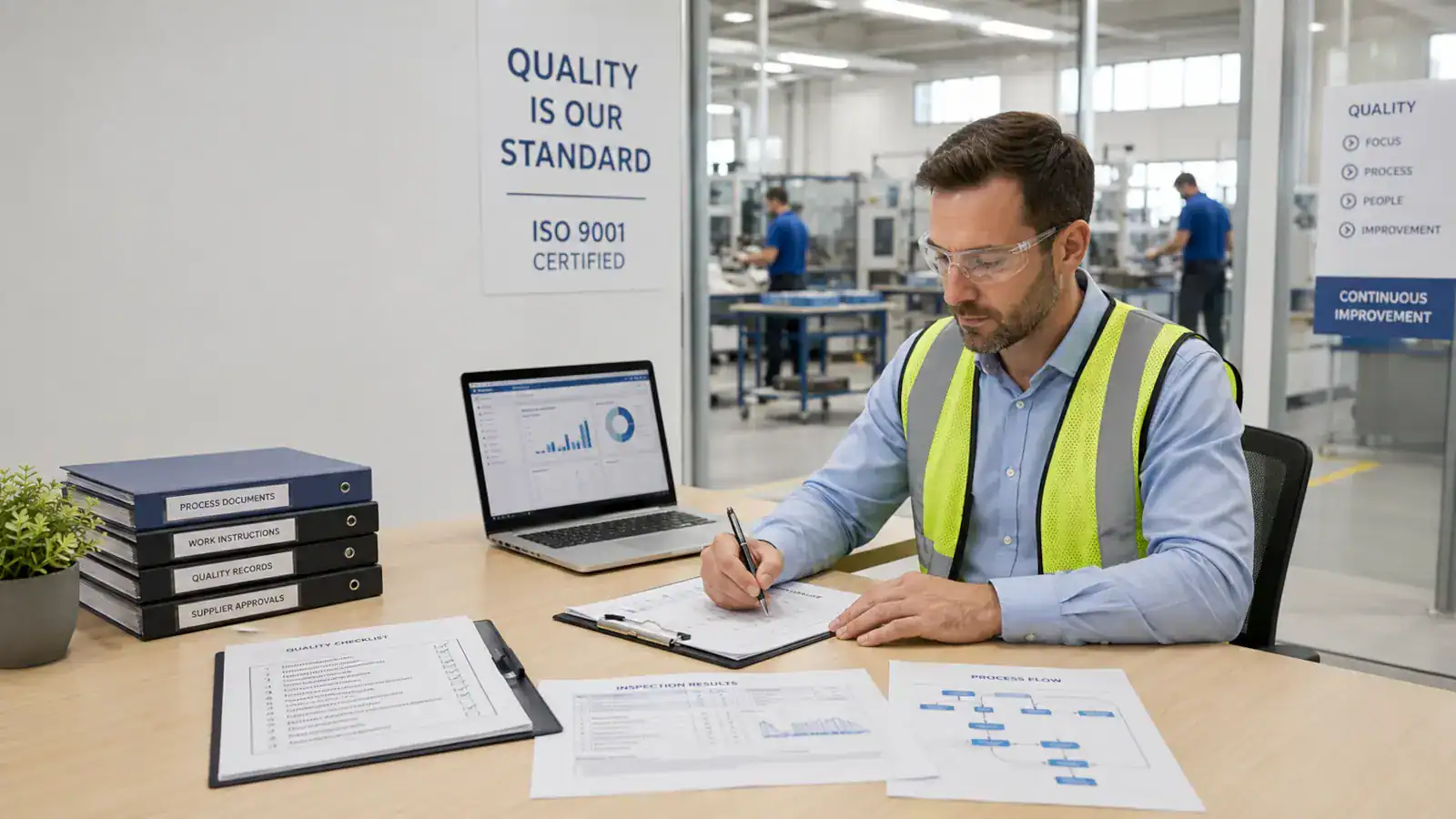
ISO 9001 is the international standard for quality management systems.
It provides a framework for organisations to deliver consistent products and services, improve processes, meet customer requirements and manage quality in a structured way.
For SHEQ professionals, ISO 9001 is important because quality is often managed alongside safety, health and environmental responsibilities. Many SHEQ roles include responsibility for ISO 9001, ISO 14001 and ISO 45001 as part of an integrated management system.
This guide explains what ISO 9001 is, how it works, what certification means and why it matters for SHEQ careers.
What Is ISO 9001?
ISO 9001 is a management system standard for quality.
It sets out requirements for a quality management system, often shortened to QMS.
The purpose of a QMS is to help an organisation consistently provide products and services that meet customer, legal and regulatory requirements.
ISO 9001 can apply to almost any type of organisation, including:
- manufacturing companies
- construction businesses
- engineering firms
- service providers
- logistics companies
- facilities management providers
- training providers
- public sector organisations
- charities
- professional services firms
ISO 9001 does not tell every organisation exactly how to operate. Instead, it provides a framework that can be applied in different sectors and organisational contexts.
What Is a Quality Management System?
A quality management system is the way an organisation controls and improves the processes that affect the quality of its products or services.
It may include:
- policies
- procedures
- process maps
- roles and responsibilities
- document control
- customer requirements
- supplier controls
- inspection and testing
- internal audits
- non-conformance management
- corrective actions
- performance monitoring
- management reviews
The purpose is not simply to create documents for an audit.
A good quality management system should help an organisation understand how work is done, where things can go wrong and how performance can be improved.
KEY POINT
ISO 9001 is not only about product inspection. It is about managing the processes that lead to consistent quality, customer satisfaction and continual improvement.
Why Is ISO 9001 Important?
ISO 9001 is important because poor quality can create significant problems.
These may include:
- customer complaints
- product failures
- service errors
- rework
- waste
- delays
- contract disputes
- loss of reputation
- failed audits
- regulatory issues
- increased costs
A quality management system helps organisations prevent these problems by making processes clearer, responsibilities more defined and improvement more systematic.
ISO 9001 can also support business development. Many clients, especially larger organisations and public sector buyers, expect suppliers to have a recognised quality management system.
In some sectors, ISO 9001 certification can make the difference between being able to tender for work and being excluded from supply chain opportunities.
ISO 9001 and Customer Satisfaction
Customer focus is central to ISO 9001.
The standard encourages organisations to understand customer requirements, deliver products or services consistently and monitor whether customers are satisfied.
This does not mean simply reacting when customers complain.
It means building quality into the process from the start.
For example, an organisation may need to consider:
- what the customer has asked for
- what has been agreed in the contract
- what legal or regulatory requirements apply
- what specifications, drawings or standards must be followed
- what evidence the customer expects
- what acceptance criteria apply
- how changes will be controlled
- how feedback and complaints will be handled
For SHEQ professionals, this matters because customer requirements often overlap with safety, environmental and compliance requirements.
ISO 9001 and Legal Compliance
ISO 9001 is not a legal compliance standard in the same way that health and safety or environmental legislation creates legal duties.
However, it does require organisations to understand and meet applicable statutory and regulatory requirements relating to their products and services.
This may include requirements linked to:
- product safety
- testing and inspection
- technical standards
- certification
- traceability
- record keeping
- customer contracts
- sector-specific regulations
The key point is that quality is not just about what the customer wants. It also includes what the organisation is legally and technically required to provide.
A strong QMS should help the organisation identify those requirements and ensure they are built into relevant processes.
The Structure of ISO 9001
ISO 9001 follows the same broad management system structure used by other major ISO standards.
This makes it easier to integrate with ISO 14001 for environmental management and ISO 45001 for occupational health and safety.
The main clauses include:
- Clause 4: Context of the organisation
- Clause 5: Leadership
- Clause 6: Planning
- Clause 7: Support
- Clause 8: Operation
- Clause 9: Performance evaluation
- Clause 10: Improvement
These clauses follow the Plan-Do-Check-Act approach often used in management systems.
The organisation plans what it needs to do, operates its processes, checks performance and takes action to improve.
Clause 4: Context of the Organisation
Clause 4 requires the organisation to understand its context.
This means considering internal and external issues that may affect the quality management system.
Examples may include:
- customer expectations
- market conditions
- legal and regulatory requirements
- supply chain risks
- available resources
- workforce competence
- technology
- organisational structure
- economic pressures
- sector standards
- climate-related issues where relevant
The organisation must also understand the needs and expectations of relevant interested parties.
These may include:
- customers
- regulators
- employees
- suppliers
- certification bodies
- owners or shareholders
- contractors
- end users
- insurers
Understanding context helps make the QMS specific to the organisation rather than a generic set of procedures.
Clause 5: Leadership
Leadership is central to ISO 9001.
Top management must demonstrate commitment to the quality management system.
This may include:
- setting a quality policy
- assigning responsibilities
- ensuring quality objectives are established
- integrating quality into business processes
- promoting customer focus
- supporting process owners
- providing resources
- reviewing performance
- encouraging improvement
ISO 9001 should not be treated as something owned only by the Quality Manager or SHEQ Manager.
Senior leaders and operational managers need to be involved because they influence priorities, resources and culture.
PRACTICAL INSIGHT
A quality management system will struggle if it is treated as a separate “quality department” activity. ISO 9001 works best when quality is built into everyday business processes and management decisions.
Clause 6: Planning
Planning requires the organisation to address risks and opportunities.
In ISO 9001, risk-based thinking helps organisations identify what could affect their ability to provide consistent products and services.
Risks may include:
- unclear customer requirements
- supplier failure
- lack of competence
- poor document control
- equipment failure
- process variation
- inspection gaps
- production delays
- design changes
- communication failures
- loss of key staff
Opportunities may include:
- process improvement
- better supplier controls
- reduced rework
- improved customer feedback
- automation
- training improvements
- clearer documentation
- stronger audit processes
Planning also includes setting quality objectives and deciding how those objectives will be achieved.
Good objectives should be measurable, relevant and linked to business performance.
Clause 7: Support
Clause 7 focuses on the resources and support needed for the quality management system to work.
This includes:
- people
- competence
- awareness
- communication
- documented information
- infrastructure
- equipment
- work environment
- monitoring and measuring resources
- organisational knowledge
Competence is especially important.
People need the knowledge, training and experience required to do work that affects quality.
Documented information is also a major part of ISO 9001. This may include procedures, forms, records, specifications, drawings, manuals, work instructions and audit reports.
However, documentation should support the process. It should not become a burden that adds little value.
Clause 8: Operation
Clause 8 is where ISO 9001 connects most directly with day-to-day work.
It covers the planning and control of operational processes.
Depending on the organisation, this may include:
- understanding customer requirements
- reviewing contracts and orders
- designing or developing products and services
- controlling suppliers and subcontractors
- producing goods or delivering services
- identifying and tracing outputs
- protecting customer property
- preserving products
- controlling changes
- releasing products or services
- controlling nonconforming outputs
This is often the largest and most practical part of the quality management system.
For SHEQ professionals, Clause 8 is important because it shows whether the organisation’s procedures actually reflect how work is controlled.
If operational controls are weak, the organisation may produce defects, miss customer requirements, fail inspections or lose control of important information.
Clause 9: Performance Evaluation
Clause 9 requires the organisation to monitor, measure, analyse and evaluate quality performance.
This may include:
- customer satisfaction
- complaints
- audit findings
- process performance
- supplier performance
- non-conformances
- corrective actions
- inspection results
- rework
- warranty claims
- delivery performance
- quality objectives
- management system performance
Internal audits are a key part of performance evaluation.
They help the organisation check whether the quality management system meets ISO 9001 requirements, whether internal processes are being followed and whether the system is effective.
Management review is also important.
Senior management should review quality performance, risks, opportunities, audit results, customer feedback, resource needs and improvement actions.
Clause 10: Improvement
Clause 10 focuses on improvement.
This includes dealing with nonconformities and taking corrective action.
A nonconformity occurs when a requirement is not met. This could relate to a customer requirement, legal requirement, internal procedure, product specification, audit requirement or ISO 9001 requirement.
Corrective action should address the cause of the problem, not just the immediate issue.
For example, if a product was supplied with the wrong documentation, the immediate correction might be to send the correct documents. The corrective action may involve reviewing document control, training, order review or final release processes to prevent the issue happening again.
Improvement may also come from:
- audit findings
- customer feedback
- process data
- staff suggestions
- management review
- supplier performance reviews
- complaints and defects
- lessons learned
A strong QMS helps the organisation learn from problems rather than repeatedly fixing the same issues.
AUDIT TIP
When auditing ISO 9001, do not only ask whether a procedure exists. Follow the process: check what the customer required, how the work was controlled, what evidence was kept and what happened when something went wrong.
ISO 9001 Certification Explained
ISO 9001 certification is a formal assessment by an external certification body.
If the organisation meets the requirements of the standard, it can be certified to ISO 9001.
Certification usually involves:
- reviewing the organisation’s quality management system
- checking documentation and records
- interviewing managers and employees
- sampling operational processes
- reviewing internal audits
- reviewing non-conformances and corrective actions
- checking management review evidence
- carrying out surveillance audits after certification
Certification is voluntary unless required by a client, contract, sector scheme or supply chain requirement.
Many organisations pursue ISO 9001 certification because it can improve credibility, support tendering, strengthen customer confidence and provide external assurance.
However, certification should not be treated as the end goal.
The real value comes from using the quality management system to improve performance and reduce problems.
Is ISO 9001 Mandatory?
ISO 9001 is not generally mandatory.
An organisation can manage quality without being certified to ISO 9001.
However, certification may be required or strongly preferred by:
- major clients
- public sector procurement frameworks
- principal contractors
- regulated sectors
- corporate groups
- supply chains
- international customers
- certification schemes
For many organisations, ISO 9001 certification is commercially important because it helps demonstrate that quality is being managed through a recognised system.
For smaller organisations, the decision to pursue certification should be based on customer needs, business objectives, risk and available resources.
A simple, well-run quality system may be more useful than an overly complex system created only to pass an audit.
ISO 9001 and Integrated Management Systems
ISO 9001 is commonly used as part of an integrated management system.
An integrated management system may combine:
- ISO 9001 for quality
- ISO 14001 for environmental management
- ISO 45001 for occupational health and safety
This can be useful because the standards share a similar structure.
Common processes may include:
- document control
- internal audits
- corrective actions
- management review
- objectives
- competence and training
- communication
- risk and opportunity management
- performance monitoring
For SHEQ professionals, integrated management systems are especially important because many organisations want one joined-up system rather than separate systems for safety, environment and quality.
This can reduce duplication and make the system easier for managers and employees to use.
ISO 9001 and SHEQ Careers
ISO 9001 knowledge is valuable for many SHEQ roles.
It is particularly relevant for:
- SHEQ Advisors
- HSEQ Coordinators
- Quality Advisors
- Quality Managers
- Compliance Managers
- Management Systems Officers
- Internal Auditors
- SHEQ Managers
- Operations Managers with quality responsibilities
Understanding ISO 9001 can help professionals support audits, manage non-conformances, review procedures, improve document control and contribute to management system development.
For people moving into SHEQ, ISO 9001 can also help connect quality, compliance and operational improvement.
This is useful because many SHEQ roles require more than health and safety knowledge. Employers may also want people who can maintain systems, support audits, manage corrective actions and improve processes.
Useful Training for ISO 9001
The right training depends on your role.
Common training routes include:
- ISO 9001 awareness training
- ISO 9001 implementation training
- ISO 9001 internal auditor training
- ISO 9001 lead auditor training
- quality management training
- CQI or IRCA-related training
- integrated management systems training
An awareness course may be enough for someone who needs to understand the standard at a general level.
Internal auditor training is useful for people who will audit the system inside an organisation.
Lead auditor training is more advanced and is often relevant for consultants, certification auditors or senior management systems professionals.
For SHEQ professionals, ISO 9001 training is often most useful when combined with practical experience of audits, non-conformance management, corrective actions and process improvement.
CAREER TIP
ISO 9001 training can strengthen a SHEQ or compliance CV, especially for management systems roles. However, employers will also want evidence that you can apply the standard practically through audits, corrective actions, document control and process improvement.
Common Mistakes With ISO 9001
Some organisations implement ISO 9001 well. Others treat it as a paperwork exercise.
Common mistakes include:
- copying generic procedures
- focusing on certification rather than improvement
- weak customer requirement review
- poor document control
- ineffective internal audits
- non-conformances that are not investigated properly
- corrective actions that do not address root causes
- supplier controls that are too weak
- objectives that are vague or not measured
- management reviews that do not lead to action
For SHEQ professionals, recognising these weaknesses is important.
ISO 9001 is most useful when it helps the organisation control work, satisfy customers and improve performance.
ISO 9001:2015, Climate Change and the Upcoming Revision
At the time of writing, ISO 9001:2015 remains the current published standard, with a 2024 amendment covering climate action changes.
That amendment means organisations need to consider whether climate change is a relevant issue within the context of their management system.
This does not turn ISO 9001 into an environmental management standard. ISO 14001 remains the main standard for environmental management.
However, climate-related issues may still be relevant to quality if they affect customers, suppliers, materials, logistics, resilience, product conformity or service delivery.
ISO 9001 is also currently being revised. ISO/FDIS 9001 is in the approval phase, with the new edition expected to replace ISO 9001:2015 in September 2026.
For SHEQ professionals, this is a reminder that management system standards change over time.
Organisations should keep their systems, training and certification arrangements under review rather than assuming that existing documentation will remain suitable indefinitely.
Final Thoughts
ISO 9001 is the international standard for quality management systems.
It helps organisations manage processes, meet customer and regulatory requirements, improve performance and reduce avoidable problems.
For SHEQ professionals, ISO 9001 is important because quality often sits alongside health and safety, environmental management and compliance within an integrated management system.
Certification can provide useful assurance, but the real value of ISO 9001 is not the certificate itself.
The real value is a quality management system that helps the organisation understand its processes, control risk, satisfy customers and improve over time.
For anyone building a SHEQ, compliance or management systems career, ISO 9001 is one of the core standards worth understanding.
Continue Your SHEQ Career Journey
Explore jobs, qualifications, industry insights and professional development opportunities across the UK.
Related Articles
ENVIRONMENTAL MANAGEMENT
ISO 14001 Explained: A Practical Guide for SHEQ Professionals
Understand what ISO 14001 is, how environmental management systems work and why the standard matters for SHEQ careers.
MANAGEMENT SYSTEMS
ISO 45001 Explained: A Practical Guide for SHEQ Professionals
Understand how ISO 45001 supports occupational health and safety management and how it fits into SHEQ roles.
CAREER DEVELOPMENT
What Does a SHEQ Manager Do?
Explore the responsibilities, qualifications and career routes involved in SHEQ management roles.
Join the SHEQ Connect UK Network
Get the latest SHEQ jobs, training opportunities, industry news and career insights delivered to your inbox.
No spam. Just relevant SHEQ opportunities, insights and updates.