MANAGEMENT SYSTEMS
Integrated Management Systems Explained: A Practical Guide for SHEQ Professionals
Last reviewed: June 2026 • 12 min read
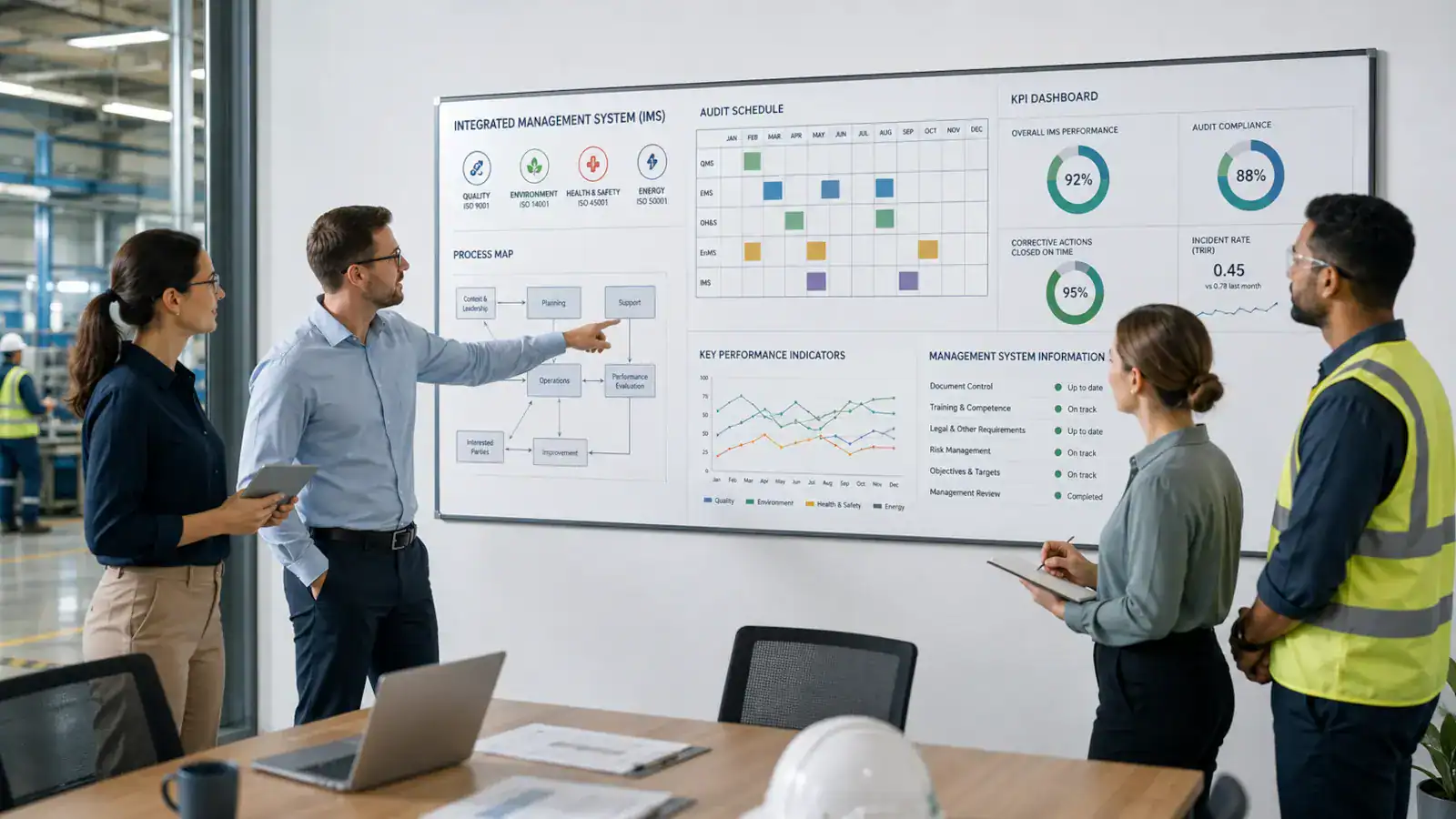
An integrated management system, often shortened to IMS, is a way of managing multiple standards, risks and business processes through one joined-up system.
For SHEQ professionals, integrated management systems are especially important because many organisations do not want separate systems for quality, environmental management and health and safety. They want one practical system that helps them manage compliance, performance, audits, corrective actions and continual improvement.
An IMS commonly combines standards such as:
- ISO 9001 for quality management
- ISO 14001 for environmental management
- ISO 45001 for occupational health and safety management
It may also include other standards, such as ISO 27001 for information security, ISO 50001 for energy management or sector-specific requirements.
This guide explains what an integrated management system is, how it works, why organisations use one and why IMS knowledge is valuable for SHEQ careers.
What Is an Integrated Management System?
An integrated management system is a single management system that brings together two or more areas of organisational control.
Instead of having separate systems for quality, environment and health and safety, an organisation can use one shared structure for common processes such as:
- policies
- leadership responsibilities
- risk and opportunity management
- document control
- training and competence
- communication
- internal audits
- corrective actions
- objectives and targets
- management review
- continual improvement
This does not mean that quality, environment and health and safety become identical. Each area still has its own specific requirements, risks and controls.
The aim is to avoid unnecessary duplication.
A well-designed IMS allows an organisation to manage different standards through one practical framework.
Why Do Organisations Use Integrated Management Systems?
Organisations use integrated management systems because separate systems can become inefficient.
For example, an organisation may have:
- one quality manual
- one environmental manual
- one health and safety manual
- separate audit schedules
- separate corrective action logs
- separate document control processes
- separate management review meetings
- separate objectives
- separate registers and spreadsheets
This can lead to duplication, confusion and inconsistent working practices.
An IMS helps bring these processes together.
Instead of asking managers to follow three different systems, the organisation can create one management framework that covers quality, environment and health and safety in a coordinated way.
This is particularly useful for organisations working under SHEQ, HSEQ, QHSE or compliance functions.
KEY POINT
An integrated management system does not remove the need to understand each individual standard. It brings common management processes together while still recognising that quality, environmental and health and safety risks are different.
Common Standards Within an IMS
The most common standards in a SHEQ-related integrated management system are ISO 9001, ISO 14001 and ISO 45001.
ISO 9001 — Quality Management
ISO 9001 focuses on quality management.
It helps organisations manage processes so they can consistently deliver products and services that meet customer, statutory and regulatory requirements.
Within an IMS, ISO 9001 may cover:
- customer requirements
- process control
- inspection and testing
- supplier management
- nonconforming outputs
- corrective actions
- customer satisfaction
- continual improvement
Quality management is often closely linked to operational performance, customer confidence and supply chain expectations.
ISO 14001 — Environmental Management
ISO 14001 focuses on environmental management.
It helps organisations identify environmental aspects and impacts, manage legal obligations and improve environmental performance.
Within an IMS, ISO 14001 may cover:
- environmental aspects and impacts
- legal compliance
- waste management
- resource use
- pollution prevention
- emergency preparedness
- environmental objectives
- lifecycle considerations
- environmental performance monitoring
For SHEQ professionals, ISO 14001 is important because environmental responsibilities are increasingly linked to client expectations, sustainability targets and corporate governance.
ISO 45001 — Occupational Health and Safety Management
ISO 45001 focuses on occupational health and safety management.
It helps organisations manage risks, prevent work-related injury and ill health, involve workers and improve health and safety performance.
Within an IMS, ISO 45001 may cover:
- hazard identification
- risk assessment
- worker consultation and participation
- operational controls
- emergency preparedness
- incident reporting and investigation
- legal compliance
- health and safety objectives
- performance evaluation
ISO 45001 is often a central part of a SHEQ management system because health and safety risks can have serious legal, human and operational consequences.
Why ISO Standards Are Easier to Integrate
Modern ISO management system standards use a common structure.
This is often referred to as the harmonised structure.
The shared structure makes it easier for organisations to integrate standards because many clauses follow the same broad pattern.
For example, ISO 9001, ISO 14001 and ISO 45001 all include sections relating to:
- context of the organisation
- leadership
- planning
- support
- operation
- performance evaluation
- improvement
This does not mean the standards are the same.
The detailed requirements differ because quality, environmental management and occupational health and safety have different purposes.
However, the common structure allows organisations to align their systems more easily.
The Main Elements of an Integrated Management System
A practical IMS usually includes several core elements.
Policy
An organisation may have separate policies for quality, environment and health and safety, or it may have one integrated policy.
An integrated SHEQ policy may describe the organisation’s commitment to:
- meeting customer requirements
- preventing injury and ill health
- protecting the environment
- complying with legal and other requirements
- consulting and involving workers
- continually improving performance
- maintaining effective management systems
The policy should be relevant to the organisation and understood by the people who need to apply it.
Leadership and Responsibilities
An IMS should make responsibilities clear.
This includes senior leadership responsibilities, management responsibilities and operational responsibilities.
A common mistake is to treat the IMS as something owned only by the SHEQ Manager or Management Systems Manager.
In reality, an integrated management system depends on involvement across the organisation.
Senior leaders set direction and provide resources. Managers control work and implement processes. Workers follow procedures, report issues and contribute practical knowledge. SHEQ professionals advise, support, monitor and improve the system.
PRACTICAL INSIGHT
An IMS will only work if operational managers see it as part of how the organisation runs, not as a separate SHEQ paperwork system maintained for audits.
Risk and Opportunity Management
Risk and opportunity management is central to most modern management system standards.
In an IMS, this may include different types of risk.
Quality risks may include:
- poor process control
- supplier failure
- product defects
- customer complaints
- missed specifications
Environmental risks may include:
- spills
- waste mismanagement
- excessive resource use
- pollution
- permit breaches
Health and safety risks may include:
- working at height
- vehicle movements
- machinery
- hazardous substances
- manual handling
- stress and fatigue
An integrated approach helps the organisation consider risk more consistently.
However, integration should not oversimplify risk. A serious safety risk is not the same as a customer complaint or an environmental aspect. Each area needs suitable assessment methods and competent judgement.
Legal and Other Requirements
An IMS can help organisations manage legal and other requirements in a structured way.
These may include:
- health and safety legislation
- environmental legislation
- product or service regulations
- customer requirements
- certification requirements
- client specifications
- insurance requirements
- sector standards
- contractual obligations
Some organisations keep separate legal registers for safety and environment. Others use one combined compliance register with different categories.
The important point is that legal and other requirements must be identified, kept up to date, understood and applied.
A register is only useful if it helps the organisation act on the requirements that apply.
Objectives and Performance Measures
Integrated management systems often include objectives and performance indicators.
Examples may include:
- reducing customer complaints
- improving audit scores
- reducing waste
- improving recycling rates
- reducing accidents
- improving near miss reporting
- closing corrective actions on time
- improving training completion
- reducing rework
- improving supplier performance
Objectives should be meaningful and measurable.
A weak objective such as “improve health and safety” is unlikely to drive action. A stronger objective would identify what will be improved, how it will be measured, who is responsible and when it will be reviewed.
Documented Information
An IMS usually includes controlled documents and records.
These may include:
- policies
- procedures
- forms
- registers
- risk assessments
- method statements
- work instructions
- audit reports
- inspection records
- training records
- incident reports
- nonconformity records
- corrective action logs
- management review minutes
One of the benefits of integration is reducing duplication.
For example, rather than having three separate document control procedures for ISO 9001, ISO 14001 and ISO 45001, the organisation can have one document control process that applies across the management system.
Documentation should be clear, current and useful.
Too much documentation can make a system harder to use. Too little documentation can make responsibilities unclear and evidence difficult to demonstrate.
Operational Control
Operational control is where the IMS connects with real work.
This may include:
- production controls
- service delivery controls
- safe systems of work
- environmental controls
- inspection and testing
- contractor controls
- supplier controls
- maintenance arrangements
- emergency preparedness
- change management
- control of nonconforming outputs
- waste management
- permit-to-work systems
The key question is whether the organisation has effective controls for the work it actually carries out.
This is where an IMS can become powerful.
A single operational process may affect quality, environment and safety at the same time.
For example, a construction activity may involve:
- quality requirements for materials and workmanship
- environmental controls for waste, dust and runoff
- health and safety controls for work at height, plant and manual handling
An integrated system can help make these controls more coordinated.
Internal Audits
Internal audits are a key part of an integrated management system.
An integrated audit can review several standards or process areas at the same time.
For example, an audit of a workshop might consider:
- quality controls
- equipment calibration
- housekeeping
- health and safety risks
- waste storage
- COSHH controls
- training records
- corrective actions
- document control
This can be more efficient than carrying out separate audits for each standard.
However, integrated audits need careful planning.
Auditors must still understand the requirements they are auditing against. A broad audit that only checks general paperwork may miss important standard-specific issues.
AUDIT TIP
Integrated audits should follow real processes, not just clauses. Start with how work is planned and delivered, then check how quality, environmental and health and safety requirements are controlled within that process.
Nonconformities and Corrective Actions
An IMS should have a clear process for dealing with nonconformities and corrective actions.
A nonconformity may relate to:
- an ISO requirement
- an internal procedure
- a customer requirement
- a legal requirement
- an operational control
- a product or service requirement
Corrective action should address causes, not just symptoms.
For example:
- A missed inspection may reveal a weakness in planning, training or supervision.
- A waste storage issue may reveal a weakness in site controls or contractor communication.
- A repeated customer complaint may reveal a weakness in process design or supplier control.
- An accident may reveal a weakness in risk assessment, maintenance or management oversight.
A single corrective action process can help the organisation track issues across quality, environment and health and safety.
This makes trends easier to identify and actions easier to manage.
Management Review
Management review is where senior leaders review whether the management system remains suitable, adequate and effective.
An integrated management review may consider:
- audit results
- customer feedback
- incident trends
- environmental performance
- health and safety performance
- quality performance
- legal compliance
- objectives
- corrective actions
- risks and opportunities
- resources
- changes affecting the organisation
- improvement opportunities
A good management review should lead to decisions and actions.
It should not simply be a meeting held because an auditor expects to see minutes.
Benefits of an Integrated Management System
A well-designed IMS can bring several benefits.
These may include:
- reduced duplication
- clearer responsibilities
- fewer separate procedures
- more efficient audits
- better management review
- stronger corrective action tracking
- improved communication
- easier certification management
- better visibility of risk
- more consistent reporting
- improved organisational learning
For SHEQ teams, integration can make the system easier to maintain.
For operational teams, it can make requirements easier to understand.
For senior leaders, it can provide a clearer picture of performance across quality, environment and health and safety.
Common Problems With Integrated Management Systems
An IMS can be useful, but it can also be implemented poorly.
Common problems include:
- combining documents without truly integrating processes
- creating a large manual that nobody uses
- losing important standard-specific requirements
- weak ownership by operational managers
- unclear responsibilities
- poor document control
- audit programmes that are too superficial
- corrective actions that are not followed up
- management reviews that become tick-box exercises
- treating certification as the main goal
Integration should make the system clearer and more effective.
If integration makes the system more confusing, more bureaucratic or less useful, the design needs to be reviewed.
IMS Certification Explained
Organisations can be certified to more than one management system standard.
For example, an organisation may hold certification to:
- ISO 9001
- ISO 14001
- ISO 45001
Certification bodies may audit these standards together as part of an integrated audit programme.
This can reduce duplication and make external audits more efficient.
However, certification is still assessed against each individual standard.
An organisation cannot simply say it has an IMS and assume that all requirements are covered.
The system must still demonstrate that it meets the requirements of each standard within scope.
What Does an IMS Manager Do?
Some organisations have a dedicated IMS Manager, Management Systems Manager or Compliance Manager.
This role may involve:
- maintaining the integrated management system
- managing document control
- planning internal audits
- coordinating external certification audits
- tracking nonconformities and corrective actions
- supporting management review
- maintaining legal or compliance registers
- reporting performance
- supporting process improvement
- training employees on system requirements
- working with department managers
In some organisations, these responsibilities sit with the SHEQ Manager.
In larger organisations, there may be a separate management systems team.
IMS Skills for SHEQ Professionals
IMS knowledge is valuable for SHEQ professionals because many roles involve more than one discipline.
Useful skills include:
- understanding ISO 9001, ISO 14001 and ISO 45001
- internal auditing
- process mapping
- document control
- risk and opportunity management
- corrective action management
- legal compliance tracking
- report writing
- data analysis
- communication
- influencing managers
- preparing for certification audits
- understanding operational processes
For people moving into SHEQ, IMS knowledge can be a useful way to connect health and safety, environmental and quality responsibilities.
It also helps demonstrate that you understand how organisations manage risk and performance through systems, not just individual tasks.
CAREER TIP
IMS knowledge can be particularly valuable for SHEQ roles because it shows you can work across quality, environment and health and safety rather than viewing each area in isolation.
Training for Integrated Management Systems
Training needs depend on the role.
Useful training may include:
- ISO 9001 awareness or internal auditor training
- ISO 14001 awareness or internal auditor training
- ISO 45001 awareness or internal auditor training
- integrated management system awareness
- integrated internal auditor training
- lead auditor training
- root cause analysis training
- process mapping training
- management systems implementation training
For many SHEQ professionals, internal auditor training is a practical starting point.
Lead auditor training may be more relevant for consultants, certification auditors or those responsible for leading audit programmes.
However, qualifications alone are not enough.
IMS competence develops through practical experience: reviewing processes, carrying out audits, managing actions, preparing for external audits and helping managers improve how work is controlled.
Integrated Management Systems and SHEQ Careers
Integrated management systems are closely linked to SHEQ careers.
Many SHEQ roles require the ability to support several systems at once.
A SHEQ Advisor may help maintain risk assessments, environmental controls, quality records and audit actions.
A SHEQ Manager may be responsible for certification, management review, objectives, reporting and improvement across all three disciplines.
A Management Systems Officer may focus more specifically on document control, audits, corrective actions and system maintenance.
Understanding IMS principles can therefore support career progression into roles such as:
- SHEQ Advisor
- HSEQ Coordinator
- SHEQ Manager
- Compliance Manager
- Management Systems Officer
- IMS Manager
- Internal Auditor
- Quality Manager
- Environmental Manager
- Health and Safety Manager
The more senior the role, the more important it becomes to understand how systems support decision-making, assurance and improvement.
Final Thoughts
An integrated management system brings multiple management system standards together into one coordinated framework.
For many organisations, this means combining ISO 9001, ISO 14001 and ISO 45001 so that quality, environmental and health and safety responsibilities are managed through shared processes.
A good IMS reduces duplication, improves consistency and helps organisations manage risk and performance more effectively.
A poor IMS becomes a collection of documents that exist mainly for audits.
For SHEQ professionals, IMS knowledge is valuable because it connects technical knowledge with organisational systems, audits, reporting, corrective actions and continual improvement.
As organisations continue to look for joined-up approaches to compliance and performance, integrated management systems will remain an important part of SHEQ practice.
Continue Your SHEQ Career Journey
Explore jobs, qualifications, industry insights and professional development opportunities across the UK.
Related Articles
ENVIRONMENTAL MANAGEMENT
ISO 14001 Explained: A Practical Guide for SHEQ Professionals
Understand what ISO 14001 is, how environmental management systems work and why the standard matters for SHEQ careers.
MANAGEMENT SYSTEMS
ISO 45001 Explained: A Practical Guide for SHEQ Professionals
Understand how ISO 45001 supports occupational health and safety management and how it fits into SHEQ roles.
MANAGEMENT SYSTEMS
ISO 9001 Explained: A Practical Guide for SHEQ Professionals
Understand what ISO 9001 is, how quality management systems work, and why the standard matters for SHEQ, compliance and management systems roles.
Join the SHEQ Connect UK Network
Get the latest SHEQ jobs, training opportunities, industry news and career insights delivered to your inbox.
No spam. Just relevant SHEQ opportunities, insights and updates.