MANAGEMENT SYSTEMS
ISO 14001 vs ISO 45001 vs ISO 9001: How They Fit Together
Last reviewed: June 2026 • 11 min read
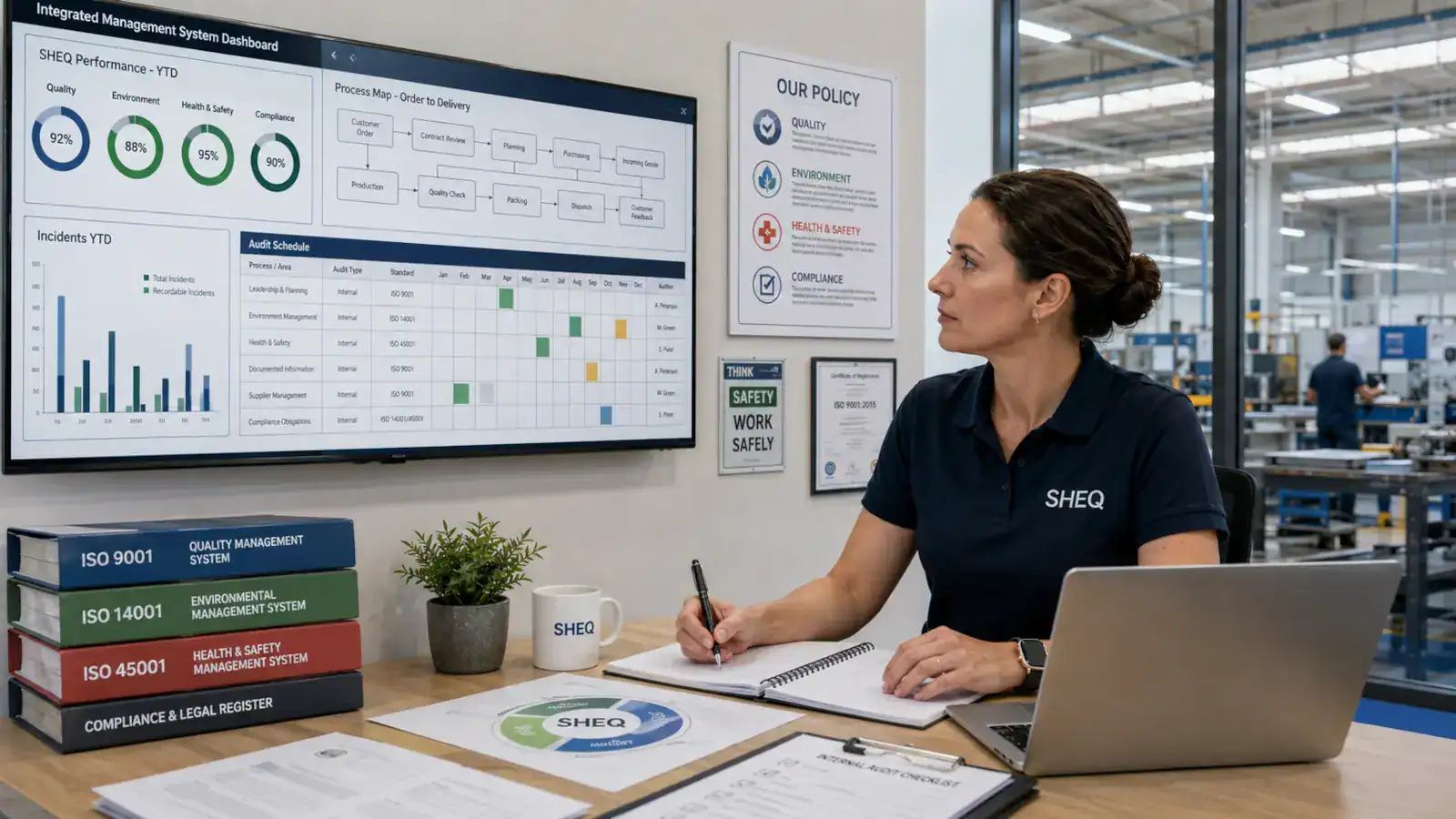
ISO 9001, ISO 14001 and ISO 45001 are three of the most widely used management system standards.
They are often found together in organisations that operate a SHEQ, HSEQ, QHSE or integrated management system.
Each standard has a different focus:
- ISO 9001 covers quality management.
- ISO 14001 covers environmental management.
- ISO 45001 covers occupational health and safety management.
Although the standards deal with different subjects, they are designed in a similar way. This makes it easier for organisations to combine them into one integrated management system.
For SHEQ professionals, understanding how these three standards fit together is extremely useful. Many SHEQ roles involve supporting more than one standard, preparing for audits, managing corrective actions, reporting performance and helping organisations improve how they control risk.
This guide explains the difference between ISO 9001, ISO 14001 and ISO 45001, how they overlap and how they can work together.
Quick Comparison
The simplest way to understand the three standards is to look at what each one is trying to manage.
| Standard | Main Focus | Common System Name | Main Question It Helps Answer |
|---|---|---|---|
| ISO 9001 | Quality | Quality Management System — QMS | Are we consistently meeting customer, legal and process requirements? |
| ISO 14001 | Environment | Environmental Management System — EMS | Are we managing environmental aspects, impacts and compliance obligations? |
| ISO 45001 | Occupational health and safety | OH&S Management System | Are we managing risks to workers and others affected by our activities? |
In practice, the three standards often overlap.
For example, a construction project may involve:
- quality requirements for workmanship and materials
- environmental controls for waste, dust, fuel and runoff
- health and safety controls for work at height, plant, electricity and manual handling
An integrated management system helps the organisation manage these requirements in a more joined-up way.
KEY POINT
ISO 9001, ISO 14001 and ISO 45001 do not replace one another. They manage different areas of organisational performance, but they can share common processes such as audits, document control, corrective actions and management review.
ISO 9001: Quality Management
ISO 9001 is the international standard for quality management systems.
It helps organisations manage processes so they can consistently provide products and services that meet customer and applicable statutory or regulatory requirements.
ISO 9001 is concerned with areas such as:
- customer requirements
- process control
- product and service conformity
- document control
- supplier management
- nonconforming outputs
- corrective actions
- customer satisfaction
- continual improvement
Quality management is not only about checking finished work.
A good quality management system helps an organisation understand how work is planned, controlled, delivered, checked and improved.
For SHEQ professionals, ISO 9001 is particularly relevant where the role includes quality assurance, compliance, process improvement, internal audits, supplier controls or customer requirements.
ISO 14001: Environmental Management
ISO 14001 is the international standard for environmental management systems.
It helps organisations identify and manage their environmental aspects, impacts, compliance obligations and improvement opportunities.
ISO 14001 is concerned with areas such as:
- environmental aspects and impacts
- compliance obligations
- waste management
- pollution prevention
- resource use
- emergency preparedness
- lifecycle perspective
- environmental objectives
- monitoring and performance evaluation
- continual improvement
Environmental management is not only about reducing carbon or writing a sustainability policy.
It includes practical controls for how an organisation affects the environment through its activities, products and services.
For SHEQ professionals, ISO 14001 is particularly relevant where the role includes waste, energy, water, emissions, environmental incidents, environmental audits, sustainability data or compliance with environmental legislation and client requirements.
ISO 45001: Occupational Health and Safety Management
ISO 45001 is the international standard for occupational health and safety management systems.
It helps organisations manage health and safety risks, prevent work-related injury and ill health, and improve occupational health and safety performance.
ISO 45001 is concerned with areas such as:
- hazard identification
- risk assessment
- operational controls
- legal and other requirements
- worker consultation and participation
- incident reporting and investigation
- emergency preparedness
- competence and awareness
- OH&S objectives
- performance evaluation
- continual improvement
ISO 45001 is not just a health and safety policy or a folder of risk assessments.
It is a management system for making sure health and safety is planned, implemented, monitored and improved across the organisation.
For SHEQ professionals, ISO 45001 is particularly relevant where the role includes risk assessments, inspections, incident investigations, worker engagement, contractor management, audit preparation or health and safety reporting.
How the Three Standards Are Similar
ISO 9001, ISO 14001 and ISO 45001 all follow a similar management system structure.
This shared structure is one of the reasons they can be integrated.
The standards all include requirements linked to:
- context of the organisation
- leadership
- planning
- support
- operation
- performance evaluation
- improvement
This means that common processes can often be managed together.
For example, an organisation may have one process for:
- document control
- internal audits
- management review
- corrective actions
- objectives and targets
- competence and training
- communication
- risk and opportunity management
The detail will differ between standards, but the management system approach is similar.
How the Three Standards Are Different
Although the standards share a structure, they do not manage the same risks.
ISO 9001 focuses on whether the organisation can consistently meet requirements and satisfy customers.
ISO 14001 focuses on how the organisation interacts with the environment and manages environmental impacts.
ISO 45001 focuses on preventing work-related injury and ill health.
The difference matters because each standard requires different knowledge and evidence.
For example:
- A quality audit may look at customer requirements, inspection records and nonconforming outputs.
- An environmental audit may look at waste controls, spill prevention and compliance obligations.
- A health and safety audit may look at risk assessments, worker consultation and incident investigations.
The standards can be integrated, but they should not be blurred together.
A weak integrated system may combine documents but lose important subject-specific controls.
Why Organisations Combine ISO 9001, ISO 14001 and ISO 45001
Organisations often combine the three standards because it is more efficient than running separate systems.
Without integration, an organisation may have:
- separate policies
- separate procedures
- separate audit schedules
- separate corrective action logs
- separate objectives
- separate management reviews
- separate document control processes
This can create duplication and confusion.
An integrated approach can make the system easier to manage.
For example, instead of having three separate audit programmes, the organisation may create one integrated audit programme that covers quality, environment and health and safety.
Instead of three separate corrective action trackers, the organisation may use one action management system.
Instead of separate management reviews, senior leaders may review performance across all three areas in one joined-up meeting.
PRACTICAL INSIGHT
Integration should make a management system easier to use, not harder. If an integrated system becomes a large collection of generic procedures that nobody understands, it has missed the point.
How They Fit Together in an Integrated Management System
An integrated management system brings multiple standards into one coordinated framework.
This does not mean every process is merged completely.
Some processes can be shared.
Others need to remain specific.
Shared Processes
Common shared processes may include:
- document control
- internal audits
- corrective action management
- management review
- competence and training
- communication
- objectives and targets
- performance reporting
- risk and opportunity review
These processes are often easier to integrate because they appear across all three standards.
For example, one internal audit procedure can explain how audits are planned, carried out, reported and followed up across ISO 9001, ISO 14001 and ISO 45001.
One corrective action process can be used for quality nonconformities, environmental issues and health and safety incidents, as long as the investigation and response are appropriate to the risk.
Standard-Specific Processes
Some processes need more specialist treatment.
For example:
- ISO 9001 may require controls for customer requirements, product release, supplier performance and nonconforming outputs.
- ISO 14001 may require processes for environmental aspects, compliance obligations, operational controls and emergency preparedness.
- ISO 45001 may require processes for hazard identification, worker participation, incident investigation and OH&S risk control.
These areas should not be oversimplified.
A good integrated system keeps common management processes joined up, while still maintaining technical depth where each standard needs it.
Example: Contractor Management
Contractor management is a good example of how the standards can fit together.
A contractor may affect quality, environmental performance and health and safety at the same time.
From an ISO 9001 perspective, the organisation may need to check whether the contractor can meet specification, competence, workmanship and service requirements.
From an ISO 14001 perspective, the organisation may need to check whether the contractor can manage waste, prevent pollution, control materials and comply with environmental requirements.
From an ISO 45001 perspective, the organisation may need to check whether the contractor can manage health and safety risks, provide suitable risk assessments and follow site controls.
An integrated contractor management process can cover all three areas.
This avoids asking operational managers to follow separate contractor processes for quality, environment and health and safety.
Example: Internal Audits
Internal audits are another area where integration can work well.
An integrated audit might review a process, site or department against all three standards.
For example, an audit of a workshop might consider:
- quality records
- equipment calibration
- training and competence
- housekeeping
- waste storage
- hazardous substances
- inspection and testing
- incident reporting
- corrective actions
- document control
- environmental controls
- health and safety controls
This gives a more realistic view of how the organisation actually operates.
However, integrated audits still need competent auditors.
The auditor must understand the requirements being audited and gather suitable evidence for each standard.
AUDIT TIP
A good integrated audit follows the process, not just the clause numbers. Start with how work is planned and delivered, then check how quality, environmental and health and safety requirements are controlled in practice.
Example: Corrective Actions
Corrective actions are common to all three standards.
A corrective action process may be used for:
- customer complaints
- product defects
- environmental incidents
- health and safety incidents
- audit nonconformities
- legal compliance gaps
- process failures
Using one corrective action system can help the organisation track issues more consistently.
It can also help identify trends.
For example, repeated findings across different areas may point to a wider issue with training, supervision, communication or management review.
However, corrective actions should still be proportionate.
A minor documentation issue should not be treated the same way as a serious safety incident or environmental breach.
How the Standards Support SHEQ Roles
The three standards align closely with SHEQ responsibilities.
SHEQ stands for Safety, Health, Environment and Quality.
ISO 45001 supports the safety and health part of SHEQ.
ISO 14001 supports the environmental part.
ISO 9001 supports the quality part.
Together, they provide a structured framework for many SHEQ roles.
A SHEQ Advisor may support inspections, audits, risk assessments, environmental controls, quality records and corrective actions.
A SHEQ Manager may be responsible for management review, certification, policy, performance reporting, improvement plans and leadership engagement across all three standards.
A Management Systems Officer may focus on document control, audit schedules, nonconformity tracking, compliance registers and system maintenance.
Understanding how the standards fit together helps SHEQ professionals work across the full scope of the role.
Which Standard Should You Learn First?
The best standard to learn first depends on your role and career goals.
If You Are Focused on Quality or Compliance
ISO 9001 is often the best starting point.
It introduces core management system concepts such as process control, customer requirements, nonconformity, corrective action, internal audits and continual improvement.
It is also widely used across many sectors.
If You Are Focused on Environmental or Sustainability Roles
ISO 14001 is the most relevant standard.
It helps you understand environmental aspects, impacts, compliance obligations, operational controls and environmental performance improvement.
It is especially useful for Environmental Advisors, Sustainability Advisors and SHEQ professionals with environmental responsibilities.
If You Are Focused on Health and Safety Roles
ISO 45001 is the most relevant standard.
It links health and safety practice with leadership, worker participation, risk management, incident investigation and performance evaluation.
It is particularly useful for Health and Safety Advisors, SHEQ Advisors and managers responsible for OH&S management systems.
If You Are Focused on SHEQ or IMS Roles
You will probably need to understand all three.
For SHEQ and integrated management systems roles, the most useful approach is often:
- understand the purpose of each standard
- learn the shared management system structure
- develop internal audit skills
- gain practical experience with corrective actions and management reviews
- understand how operational processes affect quality, environment and health and safety
You do not need to become an expert in everything immediately.
But you do need to understand how the standards connect.
CAREER TIP
For SHEQ professionals, the value is not only knowing the wording of each standard. It is understanding how quality, environmental and health and safety requirements apply to real work, real risks and real management decisions.
Common Mistakes When Integrating the Standards
Organisations can make mistakes when trying to integrate ISO 9001, ISO 14001 and ISO 45001.
Common problems include:
- combining documents without integrating processes
- using generic procedures that do not reflect real work
- losing important subject-specific requirements
- treating certification as the main goal
- weak operational ownership
- poor internal audits
- corrective actions that are not followed up
- management reviews that do not lead to decisions
- unclear responsibilities
- overcomplicated documentation
Integration should make the system clearer.
If integration makes responsibilities less clear or creates more bureaucracy, the system needs to be reviewed.
Certification and External Audits
Organisations can be certified to one, two or all three standards.
For example, an organisation may be certified to:
- ISO 9001 only
- ISO 9001 and ISO 14001
- ISO 9001, ISO 14001 and ISO 45001
Certification bodies may audit the standards together where the organisation has an integrated management system.
This can reduce duplication, but each standard is still assessed against its own requirements.
An organisation cannot rely on a general SHEQ system and assume that it meets all three standards automatically.
The system must provide evidence for each standard within the certification scope.
Why This Matters for SHEQ Careers
Many SHEQ job adverts mention one or more of these standards.
You may see requirements such as:
- ISO 9001 experience
- ISO 14001 experience
- ISO 45001 experience
- IMS experience
- internal auditor training
- lead auditor training
- management systems experience
- corrective action management
- audit preparation
- compliance monitoring
Understanding how the standards fit together can make it easier to explain your experience.
For example, if you have supported internal audits, document control, corrective actions or management review, those skills may be relevant across all three standards.
If you have worked with risk assessments, environmental controls, quality checks or incident reporting, those activities may connect to specific standard requirements.
For career development, this is important.
SHEQ roles often require people who can work across disciplines rather than stay in one narrow area.
Final Thoughts
ISO 9001, ISO 14001 and ISO 45001 are different standards with different purposes.
ISO 9001 focuses on quality management.
ISO 14001 focuses on environmental management.
ISO 45001 focuses on occupational health and safety management.
Together, they form the core of many SHEQ and integrated management systems.
The standards fit together because they share a common structure and many common management processes, including document control, audits, corrective actions, objectives, performance evaluation and continual improvement.
However, integration should not blur the differences between them.
Quality, environmental and health and safety risks still need competent, specific controls.
For SHEQ professionals, understanding how these standards fit together is valuable because it supports auditing, compliance, reporting, management system maintenance and career progression.
A good integrated system is not just three certificates on a wall.
It is a practical framework that helps an organisation manage risk, meet requirements and improve performance.
Continue Your SHEQ Career Journey
Explore jobs, qualifications, industry insights and professional development opportunities across the UK.
Related Articles
ENVIRONMENTAL MANAGEMENT
ISO 14001 Explained: A Practical Guide for SHEQ Professionals
Understand what ISO 14001 is, how environmental management systems work and why the standard matters for SHEQ careers.
MANAGEMENT SYSTEMS
ISO 9001 Explained: A Practical Guide for SHEQ Professionals
Understand what ISO 9001 is, how quality management systems work, and why the standard matters for SHEQ, compliance and management systems roles.
MANAGEMENT SYSTEMS
Integrated Management Systems Explained
Understand how ISO 9001, ISO 14001 and ISO 45001 can work together within one integrated management system.
Join the SHEQ Connect UK Network
Get the latest SHEQ jobs, training opportunities, industry news and career insights delivered to your inbox.
No spam. Just relevant SHEQ opportunities, insights and updates.