CAREER DEVELOPMENT
What Does a SHEQ Advisor Do?
Last reviewed: June 2026 • 11 min read
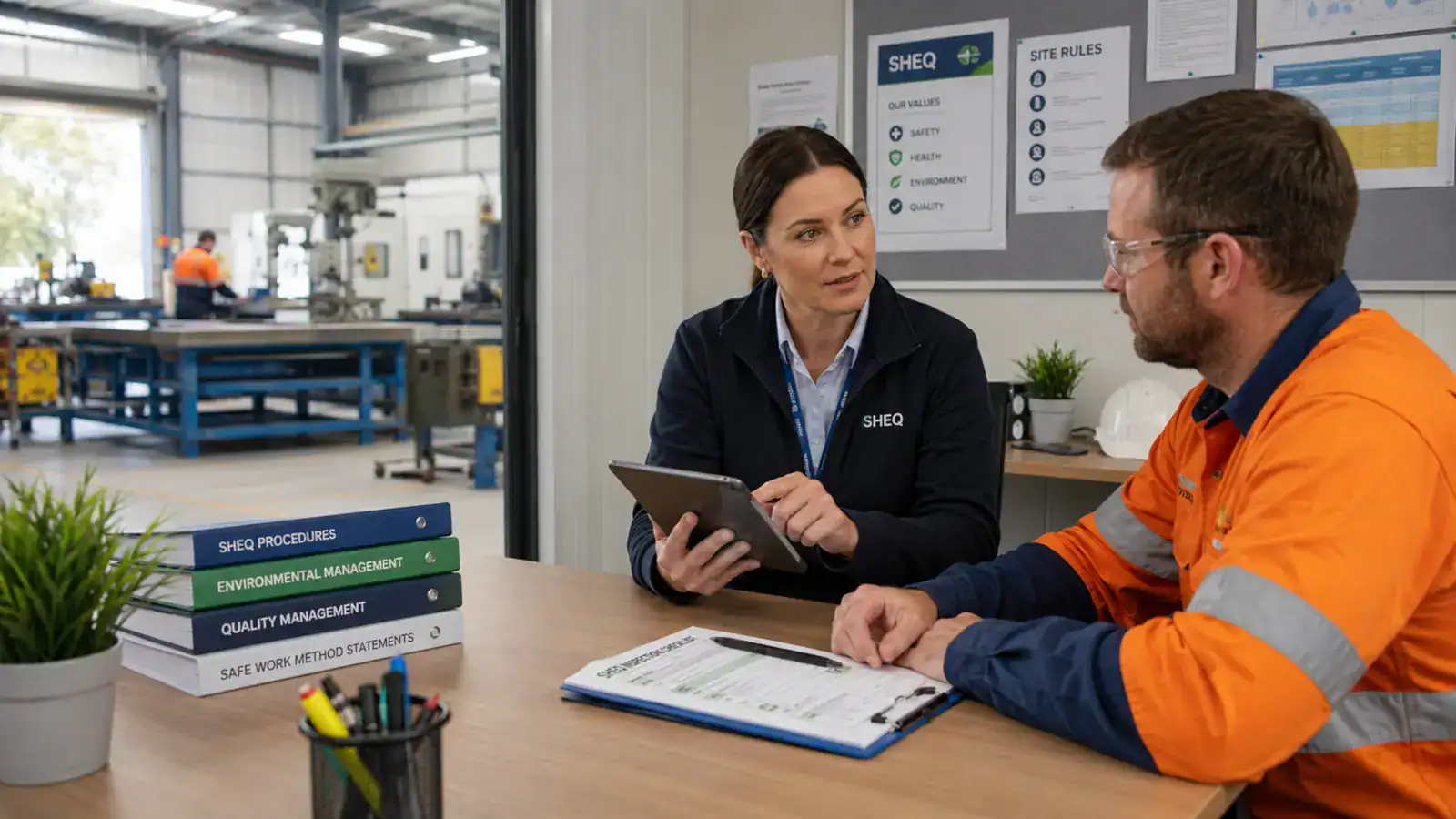
A SHEQ Advisor supports an organisation with safety, health, environmental and quality responsibilities.
SHEQ stands for Safety, Health, Environment and Quality.
The role can involve risk assessments, inspections, audits, incident investigations, environmental controls, quality processes, training, reporting and management system support.
For many people, SHEQ Advisor is an important step into a wider SHEQ career. It can provide practical experience across health and safety, environmental management, quality, compliance and ISO management systems.
The exact role varies depending on the organisation, sector and size of the SHEQ team. In some organisations, a SHEQ Advisor may focus mainly on health and safety. In others, the role may be broader and include environmental management, quality assurance, ISO 9001, ISO 14001 and ISO 45001.
This guide explains what a SHEQ Advisor does, what skills and qualifications are useful, and how the role fits into a wider SHEQ career pathway.
What Does SHEQ Stand For?
SHEQ stands for:
- Safety
- Health
- Environment
- Quality
You may also see similar job titles such as:
- HSEQ Advisor
- SHE Advisor
- EHS Advisor
- QHSE Advisor
- HSQE Advisor
- Health, Safety and Environmental Advisor
- Compliance Advisor
The order of the letters may change, but the role usually involves helping an organisation manage risk, meet legal and client requirements, improve performance and maintain effective systems.
What Is the Main Purpose of a SHEQ Advisor?
The main purpose of a SHEQ Advisor is to support managers, supervisors and employees in managing SHEQ responsibilities effectively.
A SHEQ Advisor is not usually the person who directly controls day-to-day operations. That responsibility normally sits with operational managers and supervisors.
Instead, the advisor provides guidance, support, monitoring and challenge.
A SHEQ Advisor may help answer questions such as:
- Are risk assessments suitable and up to date?
- Are site controls being followed?
- Are incidents being reported and investigated properly?
- Are environmental controls in place?
- Are quality procedures being followed?
- Are corrective actions being closed out?
- Are employees and contractors aware of their responsibilities?
- Are legal, client and management system requirements being met?
The role is practical and people-focused. A good SHEQ Advisor needs to understand the requirements, but also needs to work constructively with the people applying them.
KEY POINT
A SHEQ Advisor supports the organisation to manage safety, health, environmental and quality responsibilities. They advise, inspect, audit, report and follow up actions, but operational managers still retain responsibility for controlling the work.
Common Responsibilities of a SHEQ Advisor
The responsibilities of a SHEQ Advisor vary, but most roles include a mixture of site support, documentation, audits, incident work and communication.
Common responsibilities include:
- carrying out site inspections
- supporting risk assessments and method statements
- advising managers and supervisors
- supporting incident investigations
- monitoring corrective actions
- helping maintain ISO management systems
- supporting internal audits
- reviewing training records
- delivering toolbox talks or briefings
- assisting with environmental controls
- supporting quality and compliance processes
- preparing reports and performance data
- liaising with contractors and operational teams
In smaller organisations, the role may be broad and varied. In larger organisations, the advisor may work as part of a bigger SHEQ team with separate specialists for safety, environment, quality or management systems.
Health and Safety Responsibilities
Health and safety is often a major part of a SHEQ Advisor role.
This may include supporting:
- risk assessments
- safe systems of work
- method statements
- workplace inspections
- accident and near miss reporting
- incident investigations
- toolbox talks
- PPE arrangements
- contractor controls
- emergency procedures
- training and competence checks
- health and safety campaigns
The advisor may visit workplaces, sites, depots, workshops or offices to check whether controls are working in practice.
This could involve speaking with employees, supervisors and contractors, observing work activities, reviewing documentation and identifying areas for improvement.
The aim is not simply to find faults. A good SHEQ Advisor helps teams understand risk and make practical improvements.
Environmental Responsibilities
The environmental part of the role can include supporting the organisation’s environmental management arrangements.
This may involve:
- checking waste storage and segregation
- supporting duty of care controls
- monitoring spill prevention arrangements
- reviewing chemical or fuel storage
- supporting environmental incident reporting
- helping identify environmental aspects and impacts
- contributing to ISO 14001 requirements
- supporting energy, waste or carbon data collection
- checking environmental controls on sites
- helping respond to environmental complaints
Environmental responsibilities are increasingly important in SHEQ roles because clients, regulators and stakeholders expect organisations to show better control of environmental risks and sustainability performance.
For a SHEQ Advisor, this may mean working closely with site teams, facilities teams, contractors or environmental specialists.
Quality Responsibilities
Quality responsibilities can vary significantly between organisations.
In some roles, quality may be a major part of the advisor’s work. In others, it may be handled by a separate Quality Manager or quality team.
Where quality is part of the SHEQ Advisor role, duties may include:
- supporting ISO 9001 processes
- helping manage nonconformities
- checking documentation and records
- supporting corrective actions
- reviewing customer complaints
- assisting with process audits
- checking inspection and testing evidence
- supporting supplier or contractor reviews
- helping improve document control
Quality is not only about checking finished work. It is about making sure processes are controlled so that products or services meet requirements consistently.
For SHEQ Advisors, quality knowledge can be especially useful in organisations with integrated management systems.
Management Systems Support
Many SHEQ Advisor roles involve supporting management systems.
This may include ISO standards such as:
- ISO 9001 for quality management
- ISO 14001 for environmental management
- ISO 45001 for occupational health and safety management
The advisor may help maintain:
- policies and procedures
- registers
- audit schedules
- risk assessments
- training records
- corrective action logs
- objectives and targets
- management review evidence
- compliance records
- document control systems
In some organisations, the SHEQ Advisor may support certification audits by preparing evidence, answering auditor questions and helping close out nonconformities.
PRACTICAL INSIGHT
A SHEQ Advisor often sits between the management system and the real workplace. The role involves checking whether procedures, audits and action plans are actually working in practice.
Site Inspections and Workplace Visits
Site inspections are a common part of many SHEQ Advisor roles.
An inspection may involve checking:
- housekeeping
- access and egress
- welfare facilities
- working at height controls
- vehicle movements
- manual handling
- hazardous substances
- waste storage
- fire precautions
- equipment condition
- signage
- permits and documentation
- environmental controls
The advisor may record findings, take photographs, speak with supervisors and agree actions.
The best inspections are constructive. They identify problems, but they also recognise good practice and help teams understand what needs to improve.
Audits and Assurance
SHEQ Advisors may support internal audits and assurance activities.
Audits may look at:
- legal compliance
- ISO management system requirements
- internal procedures
- client requirements
- contractor performance
- operational controls
- training records
- incident management
- corrective action close-out
An audit is different from a basic inspection.
An inspection often checks current workplace conditions. An audit looks more deeply at whether requirements are being met and whether processes are effective.
For example, an audit may start with a procedure, then check records, interview people and review whether the process is being followed in practice.
Internal auditing is a valuable skill for SHEQ Advisors because it helps them understand systems, evidence and continual improvement.
Incident Reporting and Investigation
SHEQ Advisors are often involved when incidents, near misses or nonconformities occur.
This may include:
- gathering initial information
- speaking with those involved
- reviewing photographs or records
- identifying immediate and underlying causes
- supporting investigation reports
- recommending corrective actions
- tracking actions to completion
- sharing lessons learned
Incidents may involve injuries, near misses, environmental spills, equipment damage, quality failures or customer complaints.
A good investigation does not stop at blaming an individual. It looks at systems, supervision, training, equipment, planning, workload, communication and management controls.
The advisor’s role is to help the organisation learn and prevent recurrence.
CAREER INSIGHT
Incident investigation is one of the areas where SHEQ Advisors can develop quickly. It builds practical judgement because it requires looking beyond the immediate event and understanding why controls failed.
Training, Briefings and Communication
Communication is a major part of the role.
A SHEQ Advisor may deliver or support:
- inductions
- toolbox talks
- safety briefings
- environmental awareness sessions
- quality updates
- lessons learned briefings
- contractor briefings
- management presentations
The advisor may also prepare posters, alerts, reports, newsletters or internal updates.
Technical knowledge is important, but the ability to communicate clearly is just as important.
A SHEQ Advisor often needs to explain requirements to people who are busy, under pressure or not naturally interested in compliance. The best advisors make information practical, relevant and easy to apply.
Reporting and Performance Data
SHEQ Advisors may help collect and report performance data.
This may include:
- accident statistics
- near miss reports
- audit findings
- inspection results
- corrective action close-out
- training completion
- environmental incidents
- waste or energy data
- customer complaints
- nonconformities
- management system objectives
The role may involve updating spreadsheets, dashboards, management reports or client reports.
Good reporting helps the organisation understand trends and priorities.
For example, repeated inspection findings may show that a procedure is unclear, training is ineffective or supervisors need more support.
What Does a SHEQ Advisor Do Day to Day?
A typical day can vary widely.
One day may involve a site inspection, speaking with supervisors and following up corrective actions. Another day may involve reviewing risk assessments, preparing audit evidence, updating procedures or supporting an incident investigation.
Common day-to-day tasks include:
- visiting sites or operational areas
- reviewing documentation
- advising managers
- speaking with employees and contractors
- checking controls
- writing inspection reports
- updating action trackers
- attending meetings
- supporting audits
- preparing toolbox talks
- reviewing incidents
- collecting performance data
The role often involves balancing office-based work with practical workplace engagement.
That variety is one of the reasons SHEQ Advisor roles can be a strong development step.
SHEQ Advisor vs SHEQ Manager
A SHEQ Advisor and SHEQ Manager may work closely together, but they are not always the same role.
A SHEQ Advisor usually focuses more on practical support, inspections, audits, advice and action follow-up.
A SHEQ Manager is more likely to be responsible for overall strategy, management system ownership, leadership reporting, team management, external certification, policy direction and senior management engagement.
In smaller organisations, the difference may be less clear. A SHEQ Advisor may carry significant responsibility, while a SHEQ Manager may still be very hands-on.
In larger organisations, the difference is usually more defined.
A typical progression route might be:
SHEQ Coordinator
→ SHEQ Advisor
→ Senior SHEQ Advisor
→ SHEQ Manager
→ Head of SHEQ
However, progression depends on experience, competence, qualifications and the organisation’s structure.
What Skills Does a SHEQ Advisor Need?
A SHEQ Advisor needs a mix of technical, organisational and interpersonal skills.
Useful skills include:
- risk assessment
- workplace inspection
- incident investigation
- auditing
- report writing
- communication
- attention to detail
- problem solving
- influencing
- confidence to challenge poor practice
- environmental awareness
- quality awareness
- management systems knowledge
- data handling
- time management
- practical judgement
The role suits people who can work with both documents and people.
A SHEQ Advisor may need to understand legislation and standards, but also be able to stand on site, speak with a supervisor and agree practical actions.
What Qualifications Are Useful for a SHEQ Advisor?
There is no single qualification route into a SHEQ Advisor role.
However, common qualifications and memberships include:
- NEBOSH National General Certificate
- IOSH Managing Safely for managers or supervisors moving towards SHEQ
- IOSH Level 3 Certificate
- TechIOSH where experience and criteria are met
- ISEP Foundation Certificate or Certificate for environmental and sustainability knowledge
- AISEP or PISEP membership where appropriate
- ISO 9001, ISO 14001 or ISO 45001 internal auditor training
- fire safety training
- construction, manufacturing or sector-specific safety training
- environmental management training
For many SHEQ Advisor roles, the NEBOSH National General Certificate or equivalent is a common requirement.
For broader SHEQ roles, environmental and quality knowledge can also be important.
Employers often look for a combination of qualifications, practical experience and the ability to work with operational teams.
CAREER TIP
For someone aiming for a first SHEQ Advisor role, the strongest combination is usually a recognised health and safety qualification, some environmental or quality awareness, and practical evidence of inspections, audits, risk assessments or compliance work.
How Do You Become a SHEQ Advisor?
People move into SHEQ Advisor roles from several backgrounds.
Common routes include:
- SHEQ Coordinator or Compliance Coordinator progressing into an advisor role
- tradesperson or technician moving into safety and compliance
- supervisor or manager with operational experience
- health and safety assistant progressing after qualifications
- environmental or quality professional broadening into SHEQ
- graduate route through sustainability, safety, engineering or environmental subjects
- facilities, construction or manufacturing role with compliance responsibilities
A typical route might be:
Gain operational experience
→ complete a recognised qualification
→ support inspections, audits or risk assessments
→ move into a coordinator or assistant role
→ progress into SHEQ Advisor
→ develop towards Senior Advisor or SHEQ Manager
Practical experience is important because employers want advisors who understand how work is actually carried out.
Is SHEQ Advisor an Entry-Level Role?
SHEQ Advisor is not always an entry-level role.
Some organisations use the title for relatively early-career positions. Others expect several years of relevant experience.
A junior route may be called:
- SHEQ Assistant
- SHEQ Coordinator
- HSEQ Coordinator
- Compliance Coordinator
- Health and Safety Assistant
- Environmental Coordinator
A more experienced advisor role may require:
- site experience
- audit experience
- incident investigation experience
- knowledge of ISO standards
- contractor management experience
- sector-specific knowledge
- ability to work independently
When reviewing job adverts, it is important to look at the responsibilities and required experience, not just the title.
What Sectors Employ SHEQ Advisors?
SHEQ Advisors work across many sectors, including:
- construction
- civil engineering
- rail
- utilities
- manufacturing
- logistics
- facilities management
- energy
- renewables
- waste and recycling
- housing
- healthcare
- education
- public sector
- professional services
- engineering
The role will look different in each sector.
A construction SHEQ Advisor may spend a lot of time on sites. A manufacturing SHEQ Advisor may focus more on production processes, machinery, quality controls and workplace safety. A facilities management advisor may deal with contractors, planned maintenance, client sites and compliance documentation.
Sector knowledge can therefore be valuable, especially in higher-risk industries.
What Makes a Good SHEQ Advisor?
A good SHEQ Advisor is practical, credible and approachable.
They need to understand requirements, but they also need to work with people constructively.
Good advisors tend to:
- listen before giving advice
- understand operational pressures
- explain requirements clearly
- follow up actions properly
- stay organised
- challenge poor practice professionally
- avoid unnecessary bureaucracy
- focus on real risk
- recognise good practice
- keep learning
- build trust with managers and workers
A SHEQ Advisor who only points out problems may struggle to gain influence.
A strong advisor helps people understand what needs to change and why it matters.
Is SHEQ Advisor a Good Career Move?
SHEQ Advisor can be a strong career move for someone who wants a practical role with variety and progression.
It can provide experience in:
- risk management
- compliance
- inspections
- audits
- incident investigation
- environmental controls
- quality systems
- management systems
- communication
- reporting
- continuous improvement
It can also provide a pathway into senior SHEQ, compliance, environmental, quality or management systems roles.
The role can be demanding because advisors may need to deal with incidents, conflicting priorities, difficult conversations and pressure from operational teams.
However, it can also be rewarding because the work can directly improve safety, environmental performance, quality and organisational learning.
Final Thoughts
A SHEQ Advisor supports an organisation in managing safety, health, environmental and quality responsibilities.
The role is practical, varied and often hands-on.
It may involve inspections, audits, risk assessments, incident investigations, training, environmental controls, quality processes, reporting and management system support.
For people building a SHEQ career, the role can provide valuable experience across several disciplines.
A strong SHEQ Advisor does more than complete forms or point out non-compliance. They help managers and workers understand risks, improve controls, close out actions and make better decisions.
That is why SHEQ Advisor roles are an important step in many SHEQ career pathways.
Continue Your SHEQ Career Journey
Explore jobs, qualifications, industry insights and professional development opportunities across the UK.
Related Articles
PROFESSIONAL MEMBERSHIP
ISEP Membership Explained
A practical guide to ISEP membership grades, environmental qualifications and career development for SHEQ professionals.
TRAINING & QUALIFICATIONS
NEBOSH vs IOSH: Courses, Qualifications and Membership Pathways Explained
A practical guide to NEBOSH and IOSH courses, qualifications and membership pathways for anyone planning a health and safety or SHEQ career.
CAREER DEVELOPMENT
What Does a SHEQ Manager Do?
Explore the responsibilities, qualifications and career routes involved in SHEQ management roles.
Join the SHEQ Connect UK Network
Get the latest SHEQ jobs, training opportunities, industry news and career insights delivered to your inbox.
No spam. Just relevant SHEQ opportunities, insights and updates.